Showing posts with label accessory. Show all posts

Monday, January 4, 2016

RoadAir Mini Pump

The RoadAir Mini Pump is currently available on amazon for $30.

RoadAir sent me this pump to test out and review.  Before I get to my review, I'd like to rant a little about pumps and bikes for the rest of us.

We here at Bikes For The Rest Of Us have high expectations when it comes to what should come standard on a bike.  Not long ago, Joseph started a list: fenders, chainguard (or chaincase), baskets and racks, gears, lights, brakes, lock, kickstand, bell.  I would add to that list a pump and pump peg or holder.  That used to be a standard feature on English bikes and it should be standard today. Car buyers would be dismayed if their new car did not come with a spare tire, jack, and tire iron. Why do we allow bicycle manufacturers to get away without providing the basics to deal with flat tires?

Back to reality: Most bikes sold in the USA do not come with pumps or even a pump peg to hold a frame pump.  So the essential flat tire kit for your bike bag should include a spare tube, patches, rubber cement, and a mini-pump.

I have tried out many mini-pumps over the years and eventually settled on one that was made by crankbrothers (they don't appear to make it any more).  I tested the RoadAir pump against the old crankbrothers pump.

Crank Brothers vs. Road Air. Both are less than 10 inches in length.


There are certain issues that a designer of a mini-pump has to confront.  First, there are two types of tube valves -- presta and schrader -- and the pump has to work on both of them.  My crankbrothers pump dealt with this issue with a dual head, with one side for presta and the other for schrader. You just rotate the pump head and lock it onto the corresponding valve type.  The RoadAir has a standard schrader head, but comes with a presta valve adapter.  The presta adapter is stored inside a compartment in the handle, along with a tapered nozzle and a pump needle.  This is a nice touch.

A compartment inside the pump handle holds a presta adapter, needle, and tapered nozzle.

Another issue for mini-pumps is their miniature nature (both RoadAir and crankbrothers are less than 10 inches long). Their short pistons can only pump so much air, so typically it takes a lot of work to re-inflate your tube after it's been patched.  I liked the crankbrothers pump because I could get a comfortable grip on it.  The RoadAir pump has a feature that I haven't seen before: there is actually a hose inside that you pull out and connect to the tube valve. This allows you to pump without having your hands between the spokes.  I had no trouble getting to 80 PSI (on amazon, RoadAir states that its mini-pump can inflate to a maximum PSI of 90-110).

A flexible hose pulls out from the RoadAir pump, making it easier to reach the valve.

For what it's worth, the RoadAir is lighter than my crankbrothers pump. On the other hand, the RoadAir does not come with a pressure gauge or a protective case, so that lessens the weight.  I plan to continue using the RoadAir to test out its durability and will update this review at some point.

In the comments, tell us about your pump and why you like it (or don't).

Tuesday, June 12, 2012

Wald baskets


Wald baskets vary in size and price, and are available both online and at your local bike shop.

Last week I talked about Grant Petersen's new book, Just Ride: A Radically Practical Guide to Riding Your Bike.  In his book, Petersen extols the virtues of baskets, writing:

When you're after function and can give up the French country look, forget wicker, rattan, and wood baskets, and get an easy-loading, space-efficient rectangular one made of steel wire.  The best are made by Wald, in Kentucky.  They come chrome-plated or painted black, in enough sizes and styles and mounting methods to satisfy anybody.

I was glad to read this, because I think baskets are among most underappreciated of bike accessories. Racks are great, and I recommend them, but baskets are perfect for holding groceries.  You don't need to remember your panniers or bungee cords.


The advantages of baskets go well beyond grocery shopping.  Baskets are great for holding all kinds of objects, whether you're headed out to play hoops...


... or on your way to a party...


... a basket will come in handy.  It's one the easiest ways to make your bike more useful.

Monday, November 7, 2011

Dahon Eco 3 / Traveler Front Rack


This is a review of both the Dahon Eco 3 and the Dahon Traveler Front Rack. 

The Eco 3 was on my bike wish list because I wanted something that was easier to tote around in the car but substantial enough to carry my near 200+ lb commuting load to work (15 miles round trip). My other bike is a Torker Cargo T which doesn't ride in the car anywhere. Sometimes the social rides or bike events I want to attend are closer to the city, so the Dahon extends my range by allowing me more multi-modal trips in from the suburbs. In practice, I've used the Dahon for a charity ride, bike light giveaways, commutes to work, and making Redbox runs at the beach.
.
The Eco 3 is the budget model for Dahon and was priced at about $380 in 2010. It has a 7-speed and a chunky-looking aluminum frame that doesn't have chainstays. It comes equipped with plastic fenders, v-brakes, a straight handlebar (proprietary) with comfortable grips. The bike folds in half, which isn't a tiny package; however, the 20-inch wheels with 1.75 width tires smooth out the ride. I can't imagine have skinner tires or smaller wheels without some sort of suspension. Then again, my other ride has fat tires and a sprung saddle.

The biggest challenge was finding a way to carry stuff on the Dahon. I know, being a pack mule is not the prime purpose of the bike, but I really don't care for backpacks. I also found the backpack put too much weight to the rear of the bike. I wanted a way to carry a load on the front of the bike. 

There are Other Dahon models have a block on the front of the frame to accept a luggage truss. I really wish my Dahon had this feature, as seems less of a compromise for carrying a load. I looked into the Rixen & Kaul quick-release luggage (suggested by Richard at Cyclelicious), but I couldn't find what I wanted at a decent price. I settled on the Traveler Rack, since it's made for the bike and can carry small panniers.

The Traveler Rack is made from tubular aluminum. The bolts that shipped with the rack did not fit in the recessed holes (head was too wide), and were too short to thread into the frame mounts (shared with the fenders). The mechanics at Bikes@Vienna found some bolts that worked and installed it for me. Note that the front brakes need to be completely disconnected as they thread through the rack. I wouldn't say the rack interferes with the brakes, but it makes the cable routing a little awkward. It's suboptimal. As you can see the rack fits a set of compact panniers, holding them low and forward of the center of the wheel.

In summary, the Dahon is a great entry-level folding bike. The 20" wheels give it a ride more like a hybrid bike, but the fold isn't as fast and compact as a 16"-wheeled bike. Adding a rack makes it a great commuter, if you don't mind the somewhat low gearing of the 7-speed. I'll also note that keeping a folding bike in your cube is a great way to get people talking about bike commuting.

Saturday, May 7, 2011

A Year and a Half with the Torker Cargo-T


Back in 2009 I was looking for the perfect transportation bike. I needed something that I could ride to work, a 7+ mile ride one way that's fairly flat. I wanted to be able to commute in my work clothes, so it had to have full fenders and a decent chain guard. Another requirement was a grocery getter since we have three grocery stores within a 3 mile radius. I ended up with a Torker Cargo-T ordered from a local Torker Dealer. 

The Cargo-T is a copy of the Batavus Personal Delivery Bike minus the galvanized frame, chaincase, wheel lock, dyno hub, rear roller brakes and other Dutch goodies. The Cargo-T was a discounted 2008 version that came with a Shimano 3 speed and coaster brake with a front roller brake.

What's worked:
  • The lack of rim brakes is great for the rain (and those lazy with bike maintenance). The front brake can lock up the wheel and just requires a little grease every 6 months or so.
  • I've thought about swapping out the 26x 1.95 Kenda tires, but they've held up well, soaked up bumps and are generally forgiving
  • I'm completely spoiled by the headset lock (keeps the front wheel fixed when parked)
  • The front and rear racks are beefy and they're used to carry adult passengers in Europe, so they shrug off bags of ice and gallons of milk.
  • The step through frame is great for mounting with a full load. I guess I'm spoiled now by being able to do sidesaddle moving dismounts.
Components that were replaced:
  • The double kickstand failed on the first use. Torker sent a beefier-looking replacement and has worked flawlessly since.
  • The pedals that came with the Cargo-T were plastic with a nubby rubber surface. The nubs were ground to a pulp after a few months. Apparently they were not made to withstand hiking boots in 20 degree temps.
  • The plastic rim tape was installed incorrectly that caused a flat. I've been meaning to replace the tape in both wheels but haven't gotten around to it.
  • The rear wheel was missing a spoke nipple. I'm told this *never* happens, but yep, I was missing one.
  • The chain guard has cracked so now the bike is missing part of it (see photo). It looks, um, not so great, but it works. I would like to replace with a full chaincase if possible.
Things I've added that work well:
  • I got the ultralight mirror after seeing it on Dotties Rivendell.
  • The tiny black bell that came with the bike is now on my folder. I've added a proper Crane brass hammer strike bell that really is louder with a nice long sustain.
  • I was excited that the Cargo-T has frame mounts for a wheel lock; however, I had to zip-tie my Velo-Orange wheel lock in place because it's too narrow for the mounts. Wheel locks are great on a big heavy bike like this one. I can't image fetching carryout with a U lock.
  • The bike now has three baskets... a Wald mountless basket zip-tied to the front and two Wald folding baskets on the rear rack. All are zip-tie mount. I can carry 4 bags of groceries now.
  • The MKS RMX pedals look great and do a better job of gripping tennis shoes than rubber-topped pedals.
  • I used the light mount on the front rack and some stainless hardware to make a Planet Bike Blaze mount.
  • The sprung vinyl saddle that came with the bike worked OK, but was a little, ah, swampy in the summertime. I'm (still) breaking in my VO Model 8 saddle. It's a little squeaky at this point but it looks fantastic.

Two questions I always get: "How much does it weigh? Isn't it slow with the three speed?" OK, so it's heavy, about 50 lbs with the current array of baskets. It isn't particularly slow unless your climbing. I've had people on road bikes, after catching up with me after a stop, comment on how I was riding "faster than expected for the bike." They may have meant "for someone not wearing lycra" but I'll let that go. I like the three speed, but have often wished for a 7 or 8 speed. You'll just be in a sub-optimal gear sometimes and have to push harder... not the end of the world.

Friday, March 25, 2011

Linus Bags

While we're on the topic of Linus, did you know they also have a chic line of bike bags? 

This is from their 2011 catalogue:

From the 2011 Linus Catalogue. Click for big. Courtesy Linus Bikes.

Sunday, February 6, 2011

Bags for Bikes

We’re going to talk about bags on this post. There are literally hundreds of types of bags for carrying loads on your bicycle at price points from $20 all the way to $200 plus. A decent bag should be constructed with sturdy materials and strong stitching to last through more than one commuting season. The design of the bag is important to make sure it will stay put and provide access to its contents while keeping them out of the weather. The size or type of the bag will depend if you’re using it for camping, commuting, holding your wallet and keys, or just keeping a few tools at hand. I’ve asked Freewheel for some input as we take a look at some decent all-purpose bags that will work well for commuting but might come in handy on a light tour.


Bags that hang on your handlebars:

These are bags that can work on several handlebar types (like mustache bars) and hold smaller items (less than 5 liters, usually). They strap to your handlebars instead of to a rack.
 
 
Freewheels’ Pick: The VO Bag
Baguette Bag, which also works as a saddlebag. It cost $34. However, it holds everything I need to take with me when I'm not hauling anything: tools, spare tubes, wallet, keys, cell. There's even room leftover for small purchases. (Apparently you can also take all that out and carry a baguette around, but I haven't tried that).

Tom’s Pick: My choice is the very similar Rivendell Brand V Bar Bag is a simple tube bag with velcro straps. The V is for Vegan since it contains no leather. The form factor is exactly the same as VO’s Baguette bag.


Other choices:
Acorn has three choices of sturdy made-in-the-USA bags for handlebars A simple nylon bag like this one from REI will work fine for smaller items.
Bags for a front rack or decaleurs: For the drop-bar crowd the popular choices are the boxy bar bags, which mount best on decaleurs, which are bag mounts that are typically attached to a small front rack. Bikes that can handle a front load can holder larger porteur bags. Folders and touring bikes work well with low-mounted front panniers.
Tom’s Pick: The Pelican Porteur Bag from Swift Industries. You can custom order this colorful bag or even order it along with a rack.

 
Freewheel’s Pick: Ortleib panniers (see more under panniers below).
Other choices: Boxy bar bags constructed of canvas like those at VO and Rivendell.

Nylon quick-release bags like the Banjo Brothers and Rixen & Kaul bags. Alan from EcoVelo recommended the Rixen and Kaul bags to me for my folding bike.
A small bag maker from Philadelphia, PA, Laplander Bags, has started making a very rich-looking porteur bag on the high end of the price range.
Bags for your saddle: These bags are great for keeping on your bike with essential tools, etc. This is one type of bag you can find at your local bike store. You can get larger saddle bags (5-11 liter) but beware they may rub the backs of your legs when you pedal, if that kind of thing annoys you.
Freewheel’s Pick: His trusty VO Baguette Bag, which doubles as a saddle bag complete with a loop for your blinkie.
Tom’s Pick: Minnehaha’s medium saddle bag, made of black canvas. It looks good, holds 8 liters or so, and the prices is right. Banjo Brothers Barrel Bag is a good choice for a smaller bag.

Other Choices:
There are hordes of cyclists out there who will use nothing but traditional touring bags from Carradice and Gilles Berthoud, so you probably can’t go wrong there. You can get less expensive Asian-made copies of these bags by Zimbale and Minnehaha. Origin8 makes traditionally styled bags out of nylon instead of canvas. If you’d like something handmade then take a look at the Towpath Duffle from Laplander. If wool tweed is more your style there plenty of choices over at Rivendell.

 
Rear Panniers:
Panniers are really the superior way to carry loads down low on your rear rack. They also leave the top of the rack free for carrying children, pizza, firewood or the like.
Tom’s Pick: Dutch Double Saddle Bags like Clarijs, CleverChimp and Basil

  These are large boxy bags (40L total capacity) that straddle your rear rack and made of waterproof tarp-type material. They generally live on your bag and sometimes have cutouts to slide a lock through for good measure. The boxy shape means that you'll have heel-strike issues unless you have long chainstays, so these are not great for typical road bikes. 
Photo: Rob
Freewheel's Pick: Ortlieb. I've been using these for years to haul all kinds of stuff in all types of weather. I've carried laptops through downpours with no worries. They truly are waterproof, and virtually indestructible. They've survived my worst crashes and wipeouts. They are very easy to latch and unlatch to your racks. With four of these (2 front, 2 back), you're in good shape for bike camping and touring.

Photo: REI
Other choices:
Bushwacker, Jadd and Arkel all make heavy-duty nylon panniers in various colors and sizes.

 
Swift Industries makes very nice panniers at a reasonable price. The folks at Path Less Pedaled used these bags every day for a year if you need a recommendation.


What if you could have only one bag? So this is one of those silly bonus categories, but I had to throw it in. If you have one bag it has to do lots of things pretty well.
Freewheel’s Pick: Ortleib Panniers. They’re tough and keep your gear dry.
Tom’s Pick: Sackville SlickerSack. OK, OK, so this is an odd bag. It’s flat like a suitcase, but rounded enough not to catch a headwind. It can hold a laptop inside or a pizza or sleeping bag on top. It fits on porteur rack or Nitto Platrack. It also looks great and will probably last a long time.

 
Other types of Bags: We missed a couple types of bike bags like rack-top bags, basket bags, frame bags and bento bags. And there are plenty of bags that you can wear as well. If you have a favorite bag, please add it in the comments!

Photos: Provided by Manufacturer unless noted otherwise

Monday, January 24, 2011

München, Deutschland

Snowbound, hard-working Bikes For The Rest Of Us parked in the courtyard near Munich, Germany.

Photo Credit: Abby Ross

Wednesday, August 4, 2010

Bright Lights For The Rest Of Us


Visibility is crucial when biking. Ride with a lit highway flare in each hand. - Bicycle Safety Tips from theonion.

Highway flares?  Funny.  But here's something that's not so humorous - most cyclists don’t have lights of any kind. Among those cyclists who do have lights, most are using low-powered handlebar flashlights and blinkies.

According to the Washington Area Bicyclists Association, over half of all cyclists killed are hit while riding at night without lights, even though only 3 percent of bike riding is done at night. The issue is so important that the Washington Area Bicyclist Association (WABA) teamed up with local jurisdictions to give out over 800 free light sets last year.

If you don't have lights on your bike, now is the time!!! Daylight is rapidly decreasing every day in North America, and will continue to do so until after winter solstice. You don’t want to get caught riding in the dark, unable to be seen by motorists. The tragic outcome of riding without lights is only too real.


Courtesy Fairfax County Police.

The bike pictured above, although not one likely to be featured on Bikes For The Rest Of Us, is the kind Eco Velo has described as the "ubiquitous transportation bike." The bike belonged to a young man who was riding at night on a road in the D.C. suburbs. He was struck and killed by an 18-year-old motorist who was driving recklessly.  As you can see in the picture, the bike has a tiny reflector on the seatpost, but no lights.  I don't know whether lights would have saved his life.  What I do know is that you can't control when a reckless, drunk, and/or distracted driver will come up behind you.  You can, however, control how visible you are.

Lights can save your life. But what kind of lights should you get?

Allow me to introduce you to the fierce yet obscure debate over bike lighting.  On the one side, you have those who advocate dynamo hubs. On the other, you have the rechargeable battery faction. The truth is that both types of lights have their advantages and disadvantages.

Dynamo Hubs


Schmidt-powered light, illustrated by Robert Higdon. Courtesy Peter White Cycles.

Dynamo hubs allow you to harness your own energy to make light.  You can't get any greener than that.  If you have dynamo-powered lights, you can flick on your headlights and taillights with a single switch at anytime, just as you would if driving your car at night.  Some believe that such availability is essential to making the bicycle a viable means of transportation. And, unlike the old days, the new dynamo lights have "stand time" that keeps the lights on even when you're stopped.

When I started this blog, I was searching for bikes with dynamo-powered lights that came standard (see the first 3 posts).  Unfortunately, most bikes don't come with dynamo-powered lights.  You can, of course, add your own dynamo hub.  Your choice will most likely be between a Schmidt or Shimano hub (Update: Tom says you should also check out the Novatech hub available at Velo Orange).  Schmidt has almost no drag when the lights are off, while the Shimano does.  Shimano appears to be consistently cheaper. 

In addition to buying the dynamo hub, you will of course need to rebuild your front wheel (or have it built at your local bike shop), and you'll need to buy compatible lights.  So let me be blunt:  This is not going to be cheap.  However, advocates of dynamos argue that the investment is well worth it.  Your bike will have a dependable, renewable, off-the-grid source of light that may well last a lifetime, and you won't have any environmental waste. 

Another option (and to avoid rebuilding your front wheel) is the bottle dynamo that attaches to your front fork and generates power as your front wheel turns. You can use a bottle dynamo with standtime lights so that you still have light even when your wheel has stopped.

I highly recommend visiting Myra Simon's website.  She is a leading advocate of dynamo-powered lights.


Rechargeable Batteries


Alias HID Light from Planet Bike. The 14.4 volt lithium battery powers a 10-watt HID bulb.

On the other hand, lithium ion batteries have been getting more powerful and less expensive.  They are not only brighter than dynamo-powered lights, they are also more versatile.  For someone with multiple bikes or concerned about theft, there's an advantage to a portable light system that you can attach and remove easily.  I have the older version of Planet Bike's Alias, which has a wire connecting the light and battery.  But check out the new "wireless" Alias, pictured above.  Something else you might want to check out: Light and Motion offers a headllight/taillight combo that attaches to your helmet (Urban Velo has a write-up).

If you want to read more about the advantages of lithium ion batteries, or learn how to build your own ultra-bright battery-powered lights, I highly recommend visiting Steven Scharf's website.

How bright is bright enough?  That's another issue that's the subject of debate. Several commenters(lumpynose, Fritz, John Marr) assert that lights powered by AA or AAA batteries are adequate.  But adequate for what?  Bike lights aid the cyclist in two important ways - seeing and being seen (see Planet Bike's article on how to choose a light).  With respect to that latter, just about any type of light is "adequate."  Some even argue that reflectors alone are adequate for that purpose.  However, there is a reason why I titled this post "Bright Lights For The Rest Of Us."  If you want to use your bike in the same way that a motorist uses a car, you will want not just to be visible but to have the proper illumination for all types of lighting situations (urban, rural, etc.).  In addition, you will want to be able to ride at night for long periods of time without worrying about battery failure. I like a 10-watt headlight and a headlamp that can go up to 100 lumens. The headlight is mainly for being seen; while the headlamp is useful for seeing around bends in the road and in case you need to stop and change a flat or make repairs.

Unfortunately, I haven't found comparably bright battery-powered taillights.  The brightest are about 1/2 watt bulbs, but check with PDW and Planet Bike - they keep offering better and brighter lights every year.  In any event, most commuters I know use 2 or even 3 taillights in addition to reflectors.


Tom's taillights and triangle reflector. Courtesy Tom Wyland.

Anything that makes you more visible is a worthwhile accessory, whether it's reflective clothes, a flagpole (check out this lighted one), or "night bright tyres."

Be safe out there -- stay visible!

Thursday, July 15, 2010

Yuba Mundo V3.0


Longtail cargo bicycles are the minivans and pickup trucks of the bike world. The long load decks can hold groceries, kids or a thousand bananas. Yuba's second generation Mundo has 21 speeds and includes a load deck and fenders with flaps for $1099. The strong steel frame of the Mundo has the highest load rating of any longtail bike in the US. You can find the full specs here and close-up photos from EcoVelo here. My favorite feature? The deflopilator (say it in your best Dr. Heinz Doofenshmirtz voice).

Yuba is offering a special edition "Mundo Wheels 4 Life" that is slightly fewer features (it has 6-speeds and lacks the load deck and fenders) for $899. Even better when you purchase a Wheels 4 Life version they donate a bike to Africa or Central America. You can also get the Mundo as a frameset or e-bike.
Yuba also offers great accessories including *huge* 85 liter "Go Getter" panniers, child seats (the deck can fit two) and stoker-type bars for rear passengers. The Mundo frames have built in load platforms that also accept running boards. So if you pick up stoker bars, running boards, a soft seat and wheel skirts you're set up to ferry around the kids.

See more photos on EcoVelo Blog where they do a full review of the Mundo V3.0.


Tuesday, June 1, 2010

Bike Art of BFROU

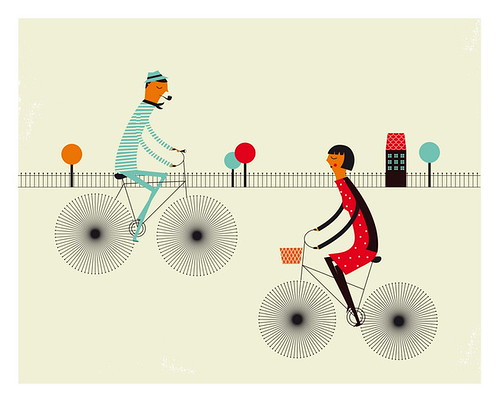
This is entitled "Freewheeling" by Blanca Gomez. I stumbled across it today and I wanted to share. It makes me want to put on a cyan fedora and take a ride.
Freewheeling

Monday, January 25, 2010

What is an Upright Ride and Where Can I Get One?

Finding a riding position that works for you is mostly an exercise of trial and error. It's mainly a matter of preference and there are no hard and fast rules; however, there are riding positions that work better for particular situations. 

Road bikes typically have their handlebars below the level of the seat; this hunched-over position is better for maximum power off the line and provides lower drag at high speeds. 

Mountain bikes with their short flat bars slip through tight places and keep your weight forward allowing the wheels to steer over rough terrain. 

Touring and trekking bikes need to have handlebars that allow for multiple positions for climbing, descending and spending long hours in a headwind

And what about those impossibly short fixie straight bars, you ask? They're good for "smashin' through traffic", apparently.

City bikes typically have a more upright ride with more weight on the saddle and less on the handlebars. This combination makes your back straight and more upright giving you a good view of the road ahead. Because you're often riding more slowly you're less concerned about aerodynamics than you are about seeing over cars or being seen. Bikes with this type of geometry are more forgiving for beginners or those carrying varying loads. For most commuters who are dragging along laptop cases, groceries, and maybe some morning coffee an upright ride makes sense. Call it the Riding Position for the Rest of Us, if you like.

Where can I get an upright ride?
If you're buying a new bike, make sure it fits. Yes, it seems obvious, but you'd be surprised how many people settle with a bike that doesn't quite fit because what the LBS had in stock or on sale. Many bike manufacturers only offer one or two sizes, so keep that in mind if you're not perfectly average in height. A properly fit bike, regardless of the type of handlebars, angle of the seat tube, etc, will feel better. Most of the bikes that we feature in Bikes for the Rest of Us have a fairly upright riding position (some more than others). Go the manufacturer sites, look up the dealers and go find a bike to test ride.

A common scenario is retrofitting a bike that you already have (or got from your Uncle, local garage sale, etc). There are some techniques that can help you make the bike more upright and appropriate for city use. Most of these solutions are fairly inexpensive and are in order of effort (but if you're going to replace your handlebars anyhow start there). Keep in mind you may have to extend your cables, particularly your front brake, if you raise your stem by more than an inch. Note: My stem examples below are for quill stems.

Raise the Handlbars
If you like your handlebars, but feel you need to get them a little higher, try raising your stem. Sheldon Brown tells you all about how to do it here.

Replacing the Stem
When you raise your stem (quill stem) you may see a line that says "minimum insertion depth" or something similar. If you see this mark the stem can't be extended any more and you may have to get a new stem. Prices and quality vary, but a good bet would be something like the Nitto Tall Stem or a Wald 511.

Get an Extender
If you need to raise your bars more than a couple of inches then consider a stem extender or stem riser. This device allows you to keep both your existing stem and handlebars, but the catch is that it's going to raise everything at least two inches. The appearance may also be a concern, but the price is right.

Replace the Handlebars
If you're not happy with your current handlebars you can get new bars that have some rise to them. Most North Roads or All-Rounder type bars have a 1-2" rise. You can find handlebars with a similar shape that have up to an 8+ inch rise. Wider bars give greater control to laden front baskets. Narrower bars like the VO/Nitto Montmarte allow you to squeeze in between tighter spots. The trick with handlebars is trying out a few, which takes time and, of course, several handlebars. Be sure to do your homework if you plan on reusing your grips, shifter or brake levers as there are different diameters of handlebars (see section on compatibility issues here).

Most of the links that I showed you are for online retailers. You may want to start with your local LBS, Bicycle Club or garage sale to see what you can find.

Photo Credit: Sketch above by Linn

Thursday, August 14, 2008

Planet Bike Rack Blinky 5


Hurray for Planet Bike.

I've liked PB for a long time, and now they've done something I've been wanted them to do for a long time: include a rack-mount with a tail-light. It's really a no brainer--if you've got a rear carrier on your bike, then the only good place to put your tail-light is the back of your rack.

The Rack Blinky 5 comes packaged with rack-mount in addition to the seatpost mount. The rack-mount is also available seperately, as it has been in the past. 
Hurray for Planet Bike!

PS for the rest of us:
This seemingly insignificant change makes the lives of your mechanic and your local bike shop's inventory staff just a bit easier, and saves you a few bucks. Both are good for you!

PS for the bikey folks (i.e. not "the rest of us"):
The rack-mount is versatile, too, allowing use of either the vertical (a la Blackburn, et al.) or horizontal (a la European, Planet Bike racks, and most others) two bolt patterns. I've also successfully bolted the mount to fenders made by Planet Bike and SKS.

Tuesday, August 12, 2008

The Xtracycle Radish

If you're looking for a perky radish, you can't go wrong with the one in Henri Rousseau's Pink Candle (see above), but since you're here at Bikes-For-The-Rest-Of-Us, I have to assume these aren't the droids you're looking for.

How about this Radish, from Xtracycle, One-Of-Our-Favorite-Companies-Ever:
The Radish is Xtracycle's latest creation: a full longtail bike that comes in one box, with everything you need to ride in style. I posted about it previously, but there is some new information from the Xtra-folks. They've designed the frame and chosen the components so that riders of various sizes can be comfortably accommodated with only a change of saddle height, so it's a one-size-fits-most arrangement. (If they're as smart as we think they are, they'll spec a bolted seat-post binder, or a wee cable to keep combat the black-market in seat-posts and saddles.)
The Xtra-folks have also disclosed these not-too-specific specifications:
  • Xtracycle-specific steel frame, mated to a matching Free Radical (powder coated, we assume),
  • Steel fork with V-brake in front,
  • Rear disc brake (cable-actuated, we assume),
  • 7 or 8 gears with "insane" range,
  • Swept-back bars and overall laid-back styling,
  • A good all-around component set (with a freehub and stout wheels, we assume),
  • Fat-G street tires (Schwalbe, we prefer; Kenda, we expect), and
  • Loads of standard accessories, including a chainguard, fenders, and the full Xtracycle longtail kit with Freeloader bags and traditional Snap Deck.
Price tag: $1199.
Radishes are almost available. Get on the Radish mailing list by emailing your contact to radish@xtracycle.com. I did.

Saturday, April 19, 2008

Basil Bags & Baskets

Holy cow, what's this? No bike?

Well, it's a Bike Accessory For The Rest Of Us.

Basil is a Dutch company that was started and is still owned by a family that has been in the bike biz for at least four generations. As you can see, they've taken some traditional and practical designs and updated them with 21st Century style and technology.
Even the swanky bag below attaches neatly to a rear carrier.

Best of all, they're now available at local bike shops across the US. If your local shop doesn't know what you're talking about, tell them that Seattle Bike Supply is the US distributor. If they still don't know what you're talking about, find a new shop.