Wednesday, November 10, 2010

Geometry

What is this, math class?

Well, Geometry is important for bicycles, due to real-world physics and engineering. That's why we often post the geometry numbers for bikes, when available.

For people who want to use a bike for transportation around their city or town, or for short recreational rides, an upright riding position can be more comfortable, safe, and easy, compared to a leaned-forward racing or mountain biking position.  We've talked about how to get an upright ride before. Some things can be done on most bikes, like changing the handlebars or stem, moving back the seat or changing the seatpost. However, the shape of the frame limits how far these changes can go.

For rider position, the most important facts are the position of the bottom bracket (the axle that connects both cranks, and therefore determines the position of the pedals) in relationship to 1) the seat, 2) the ground, and 3) the handlebars. On a long-distance touring bike you may want "drop" handlebars, with the tops level with the seat. A mountain bike used on trails will likely be set up the same, but with flat bars. For these activities, it is worthwhile to have some of your weight on the handlebars, to help with steering, and to relief the seat of some of the weight. Road racing bikes, with triathlon and time-trial bikes being the extremes, have the bars even lower, and the seat farther forward, for very leaned-over, aerodynamic position.

On the other hand, 3-speed roadsters were made for years with the handlebars swept-back, with the grips a couple of inches above the level of the seat, which was also further behind the bottom bracket. The dutch-style bikes of Europe, and American Cruiser bikes often had the handlebars even higher and further back, up to a foot above the seat, with the pedals far forward. This allows a fully-upright rider position, with the arms down at the sides, yet keeps the angle between the torso and pedals appropriate for good use of the leg muscles.

When American bike companies rediscovered the market for these sort of bikes in the 1990's, unfortunately, they developed the so-called "hybrid" as a mix of Mountain Bike and Road Bike characteristics, meant for occasional recreational cyclist. Hybrid bikes had the seat almost over the pedals, fairly low handlebars, usually straight in the mountain bike style (sometimes not even adjustable), and skinny road-style tires. 

Around the same time, the beach cruiser was revived in North America, showing pent-up demand for more comfortable, upright bikes. And updated hybrid, the Comfort Bike, was born. It used a frame about the same as a hybrid, but moved up the handlebars, often adding a suspension fork, used wider tires, and a big, soft-looking seat. Unfortunately, these bikes still usually have the seat too far forward for such an upright riding position, putting all of the effort of the thigh muscles, and none on the gluteus. 

Clever Cycles made diagrams of rider position on different types of bikes in their "Dutchness" article.  The road racer is depicted as hunched over the drops while, at the opposite end of the spectrum, a recumbent rider is leaning way back.  In the middle are the comfort bike rider and Dutch rider, sitting upright on their bikes.


Monday, November 8, 2010

Raleigh Calispel i8 and Circa i8

We have mention Raleigh's bikes several times before, but these two models had previously escaped notice.

Raleigh USA sells two very similar bikes with 8 speed Shimano Nexus internal gear hubs. The Calispel i8 is marketed as a hybrid and has 700C (622 mm) wheels with moderately wide tires, while the Circa i8 is listed as a "comfort bike", with cushy 26" x 1.95" tires. Otherwise, the frame geometry, components and accessories are about the same, including an unfortunate lack of fenders, despite the inclusion of kickstands and ample chainguards.

But what's really worth mentioning on these bikes is the list price. Both are available for only $550 at REI and at local bike shops, about the lowest price for a bike with an 8-speed internal gear hub in the North American market. Considering that the hub alone is listed at $300 and generally costs over $200, these bikes are a steal, even after adding $50 to install a set of good-quality fenders.

Raleigh Calispel i8


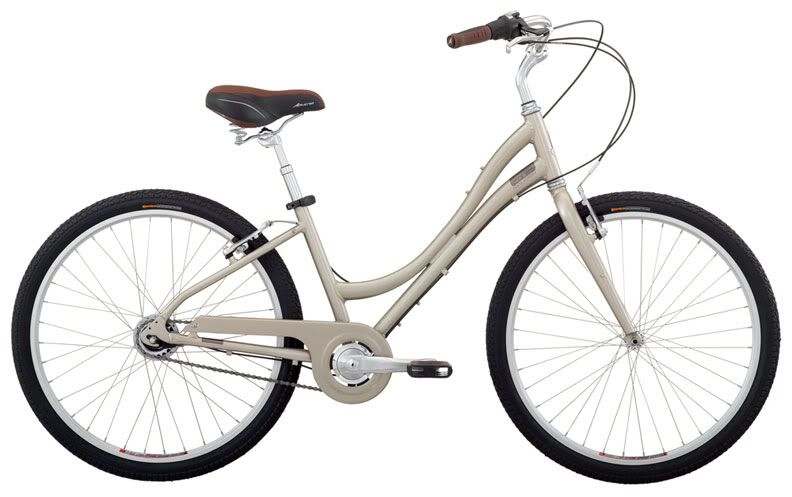
Raleigh Calispel i8 (W) - Tan Metallic - 2011

The Calispel is the "hybrid", meaning 700c x 40 mm tires and a slightly sporty look to the aluminum frame.

Geometry is "relaxed", with a 70 degree headtube and 68 degree seattube, similar to those found on classic roadsters or "Dutch" bikes. Combined with a high headtube and swept-back handlebars, and reasonable bottom bracket height, this provides an upright seating position and the ability to put a foot down easily at traffic lights. The shallow headtube angle and low fork offset (40 mm) should make the steering very stable.

Components

SIZES:  M:15, 17, 19 W:13, 15, 17
FRAME:    Atomic 13 Aluminum Hybrid, w/EASE Comfort Geometry
FORK:    Aluminum
CRANKS:    Forged Aluminum 36t Chainring
BB:    Sealed Cartridge
SHIFTER:    Shimano SL-8S20 Nexus Revo 8spd
BR.LEVERS:    Tektro
BRAKES:    Tektro V-Brake
REAR COG:  Shimano 20t
RIMS:    Weinmann XC260 Double Wall
TIRES:    Kenda K-192 w/Kshield 700x40c
PEDALS:    Avenir Comfort Platform
HANDLEBAR:    Alloy Comfort Easy Reach
STEM:    Alloy Quill
SEATPOST:    Alloy Micro Adjust Bootless Suspension 27.2x350mm
SEAT:    Avenir Deluxe Comfort
HEADSET:    Threaded 1-1/8"
COLORS:    Tan Metallic (W); Brown Metallic (M)
SPOKES:    14g Stainless Steel
GRIPS:    Avenir Comfort
EXTRAS:    Rack and Fender Mounts, Water Bottle Mounts

Raleigh Calispel i8 (M) - Brown Metallic - 2011


Raleigh Circa i8

Raleigh Circa i8 (W) - Metallic Tan - 2011

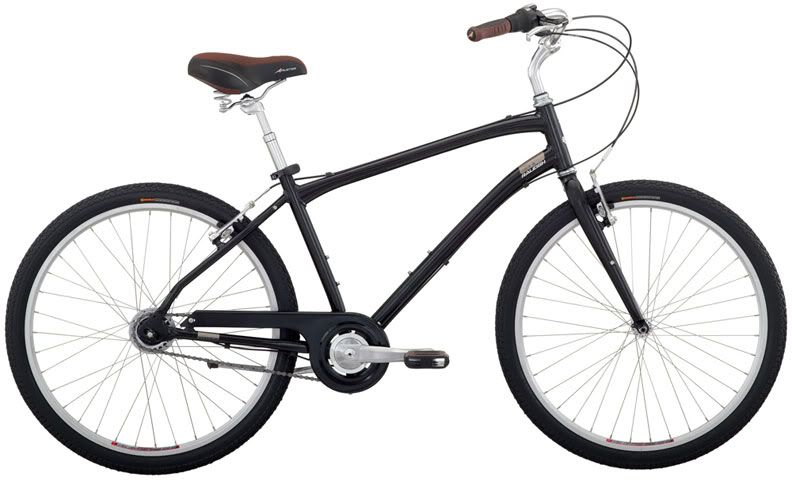
The Circa has a slightly more laid-back look, with wider Kenda K841A w/Kshield 26x1.95 (47 mm) tires on shorter 26" (559 mm) wheels. Otherwise, the geometry and components are nearly identical, and the head tube and seat tube angles are still 70 and 68 degrees, respectively.

For shorter riders or those commuting on rougher roads the Circa would be a better option, but for most medium to tall riders the medium-width 700c tires on the Calispel may be preferable. I also happen to prefer the styling of the Calispel frame, but with these two bikes you get a choice.

Raleigh Circa i8 (M) - Metallic Black


Don't forget to check out our previous posts on other Bikes for the Rest of Us by Raleigh

The Raleigh brand, like Schwinn in the US, fell far from the days when it was the largest bicycle manufacturer in England, and I am not entirely sure who owns the brand today. But it appears the new owners have been putting a good deal of thought into their bikes for the last 4 years, and the East-Asian frames and components are the same you will find on a Trek or Specialized. And the price is right.

Monday, October 25, 2010

Giant Via 1


By Joseph E

Giant Via 1 W (2011). Widely available, for about $550.

Giant has become, well, a giant among bike manufacturers. According to rumor, their Taiwanese factories also produce many frames and parts used by other brands. They got their start in the North American market making bikes on contract for Schwinn. Later, Giant decided to market it's own bikes, and has had a great deal of success in mountain, road and "hybrid" bikes.

In the last few years, Giant has also offered a few bikes more suitable for the rest of us, such as the Simple Seven and Seek 1 previously featured here. But until now Giant had not offered an upright ride with swept-back handlebars, internal hub gears, fenders and chainguard (all of which were standard on the old Schwinns, of course). Now comes the Via, which has all of these features, plus classic styling, with thin crome-moly steel tubing, curvy Mixte-style lateral stays (even on the "men's" diamond-frame model), and an elegant front basket or rear rack. 

Thanks to Taiwanese mass production, all this can be yours for under $550 with a Shimano Nexus 3-speed, or less than $500 with a SRAM derailler and 8 speed cassette. Giant has dealers in most cities, who can easily order these bikes (but good luck on finding one to test-ride).

It's a shame Giant does not offer a version of this bike with a 7-speed nexus hub, or a option to have both the front basket and rear rack installed. The chainguard may be too minimalist to fully protect your pants. But if an 8-speed derailleur or 3-speed hub, and retro steel Mixte styling are what your are looking for, this bike will be nearly as cheap as upgrading a vintage mixte, and much easier to order at your local bike shop.

Via 1 (Men's)

Specifications:

FRAME

SizesMens: S(17), M(19), L(21), XL(23)  Womens: XS(14), S(16), M(18)
ColorMens: Steel Silver/Chrome;   Womens: White/Light Green
Frame4130 Butted CroMo Steel
Fork4130 Butted CroMo Steel

COMPONENTS

HandlebarAlloy, Mid Rise & Sweep, 25.4
StemAlloy, threadless
SeatpostAlloy, 27.2
SaddleHigh-Density Foam
PedalsAlloy/Kraton Comfort Platform (Men or Women's specific)

DRIVETRAIN

ShiftersShimano Revo, Twist
BrakesAlloy, Dual Pivot
Brake LeversAlloy, Full Finger
CassetteShimano 20T, 3-Speed Internal
ChainKMC Z410RB 1/2 x 1/8, Rustproof
CranksetAlloy 3-Piece, 44T
Bottom BracketSealed Cartridge

WHEELS

RimsAlloy, Double Wall
Hubs[F] Alloy, [R] Shimano Nexus 3-Speed Internal, 32h
SpokesStainless Steel
TiresKenda Kwest w/ K-Shield, 700x32 [With puncture protection]

OTHER

"Extras" Custom Alloy Rear Rack (Men's) or Front Basket with flower stem holder (Women's), Frame Mounted U-Lock Carrier, Fenders, Chainguard, Kickstand


Geometry


SIZEHEAD ANGLESEAT ANGLETOP TUBEHEAD TUBECHAIN STAYWHEEL BASESTANDOVER HEIGHT
Men'sDegreesDegreesInchesInchesInchesInchesInches
S/17"70.0074.0022.204.9017.8042.6028.60
M/19"71.0073.0023.005.5017.8042.6029.00
L/21"71.0073.0023.706.3017.8043.2030.80
XL/23"71.0073.0024.206.9017.8043.8031.90

Women'sDegreesDegreesInchesInchesInchesInchesInches
XS/14"70.0074.0021.405.3017.8041.8022.10
S/16"71.0073.5022.056.1017.8041.8522.70
M/18"71.0073.5022.456.8917.8042.2823.50
Via 1 W (women's step-thru)

This bike is just now available for sale, but if anyone owns one or has taken a test ride, please leave a comment.

Friday, October 22, 2010

Surly Troll


The Troll as a complete bike. Credit: Surly Blog.

We already mentioned the Surly Troll in our recent discussion of "do-everything" bikes. The Troll frameset is due to arrive in November 2010, and according to Surly's blog, the MSRP will be $495. Surly has not said whether it will be offered as a complete bike in the future.

With its wide tire clearance, the Troll is designed to be an extremely versatile bike. When it was first announced on Surly's blog, they described it as "a commuter, tractor, off-roader, tourer, dethmachine."

As for the "tractor" part, it seems plain that the Troll was designed to go with Surly's new trailer. The Troll has horizontal dropouts along with a thick axle plate for installing Surly trailer-mounting nuts.

The frame has full line guides for derailleur and brake housing, fender eyelets, and disc and rim brake mounts. Both the frame and fork are equipped with mounts for front and rear racks, and the design allows the use of racks, fenders and disc brakes all at the same time.

Basically, the Troll can be whatever you need it to be, short of a carbon-lite racing bike.

Here are the specs:

Tubing: Surly 4130 CroMoly steel. TIG-welded. Main triangle double-butted

Seatpost diameter: 27.2mm

Seatpost clamp: 30.0mm Surly stainless, included

Headset/stem: 1-1/8" threadless

Bottom bracket: 73mm shell width, threaded standard English (1.37" x 24t)

Braze-ons/extras: Full-length housing line guides for derailleurs and brakes; 2 sets of water bottle cage mounts, removable post cantilever pivots; upper seatstay threaded barrels,mid-and low-blade fully threaded through-blade fork eyelets; threaded holes for racks, fenders and trailer mounting nuts; Rohloff OEM2 axle plate mounting slot

Brake compatibility: Disc and rim brake compatible. Note: rear disc brake is limited to 165mm maximum rotor diameter and requires the use of Surly caliper adapter

Tire clearance: 26 x 2.5" with rear wheel fully forward. Clearance for 2.7" tire with wheel farther back

Chainring clearance: 28/38/50t

Hub compatibility: 100mm O.L.D. front, 135mm O.L.D. rear

Fork: TIG-welded 4130 CroMoly, 100mm suspension corrected, tapered straight blade. Low- and mid-blade fully threaded through-blade rack eyelets; fender mount eyelets at dropout; 1-18" x 260mm threadless steer tube, 51mm disc mount, removable cantilever pivots, line/housing guides

Color: Agent Orange


Troll frameset. Credit: Surly

Update #1: check out Bikes to Like at Chasing Mailboxes on Pedro's Troll. 

Update #2: For 2012, Surly now offers the 29'er version of the Troll, which it calls the Ogre

Wednesday, October 20, 2010

Surly Trailer

New for 2011 - the Surly trailer.  Photo credit: Surly.
Surly plans to release the above-pictured trailer sometime during spring 2011.  According to the Surly blog, the MSRP will be $750 short, $775 long.  According to Surly, the trailer meets two requirements often lacking in bike trailers: (1) it can haul a heavy load and (2) it will work with any bike.

The trailer is constructed from TIG-welded CroMoly steel tubing.  The platform is 32 x 24". The wheels are 16" in diameter, and comes with 16 x 1.95" tires, although there is clearance for 16 x 2.5" tires. According to Surly, it can carry a load of up to 300 pounds (136 kg).

As for bike compatibility, Surly says the trailer hitch is designed to align the centerline of the trailer with the centerline of any bike. "It will work with bikes that have wheels as small as 20" and as large as 29" while keeping the bed level with the ground. This is especially important when you are hauling long items that hang off the back of the trailer (lumber, tubing, ladders, etc.)."

There are so many uses for a trailer like this:

- It's another option for the car-free. Rather than investing in a cargo bike, you can simply hook up the trailer to your bike of choice when you need to haul groceries or whatever. (On its blog, Surly notes the trailer + a new $1100 bike would cost as much as a Big Dummy (their cargo bike).

- It's another option for bike camping. Rather than investing in a touring bike, you can simply hook up the trailer and haul your camping stuff. (But don't make dad haul everything!)

- It's another option for day trips to the beach or picnic areas.

It's nice to have options.